The 4 Risk Levels of Europe’s AI Law, Explained in Depth
Introduction
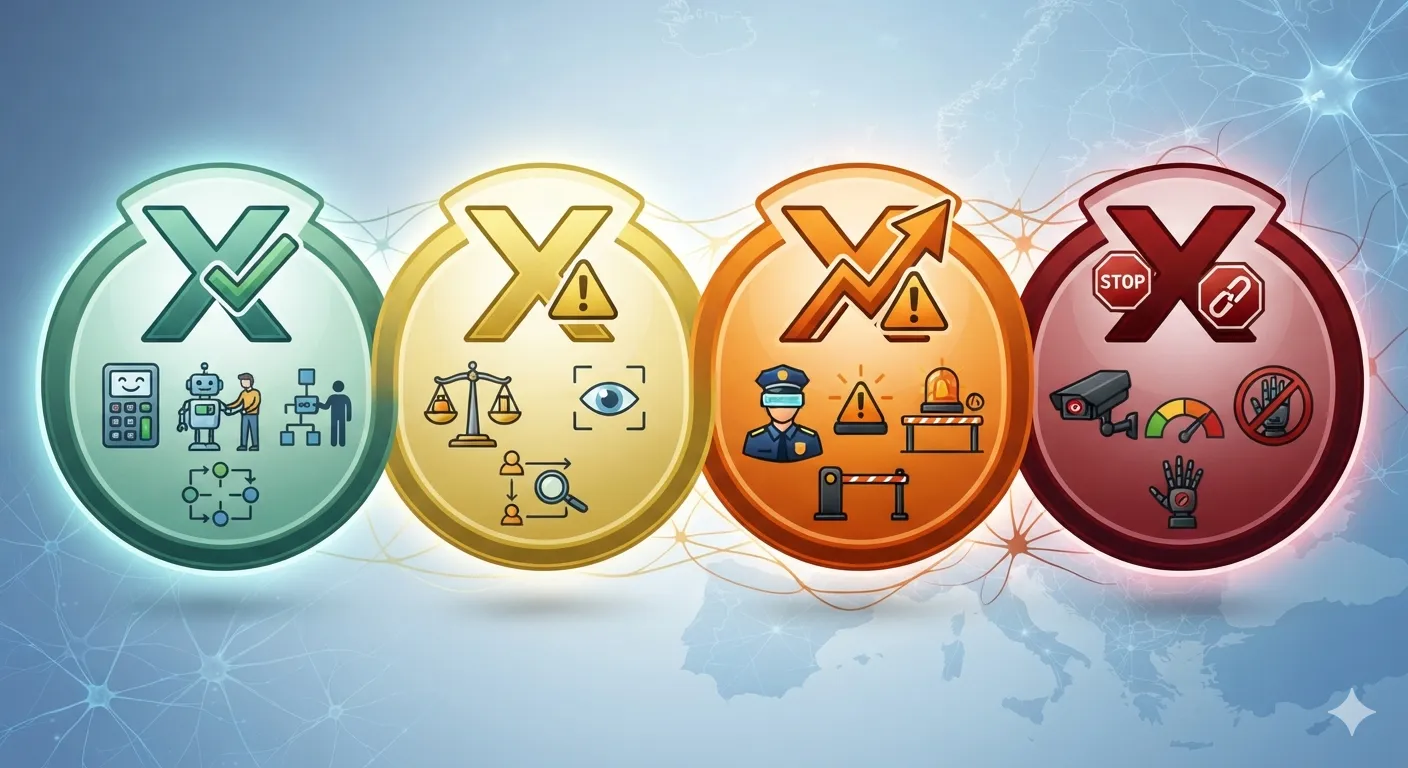
When talking about Europe’s AI Law (AI Act), the first thing to understand is its central idea: not all artificial intelligence is treated the same way. The law doesn’t apply the same rules to an AI-powered video game as it does to a system that decides whether you get a loan. Instead, it organizes every AI system into four risk levels, like a pyramid, and assigns each level a different kind of obligation — ranging from a total ban to almost complete freedom.
Understanding these four levels well is the foundation for understanding the whole law, because everything else flows from here: what a company has to do, how much non-compliance can cost, and how strictly it will be monitored.
In this post, we explain, one by one and with concrete examples, each of the four risk levels defined by the European AI Law.
🔴 Level 1: Unacceptable risk — what’s banned
This is the highest level of the pyramid, and also the easiest to understand: these are AI uses that Europe considers such a clear threat to people’s safety, rights, and dignity that it decided to ban them outright. There’s no way to “comply” at this level — it simply can’t be done.
These bans have been in force since February 2, 2025, and the law identifies eight prohibited practices:
- Subliminal or deceptive manipulation: systems that influence a person’s behavior below their level of awareness, or that deliberately deceive them, causing significant harm. For example, a video game with hidden visual or audio patterns designed to push a child into spending money without realizing it.
- Exploitation of vulnerabilities: AI that takes advantage of someone’s age, disability, or a difficult social or economic situation to distort their behavior and harm them.
- Social scoring: systems that evaluate or classify people based on their social behavior, leading to unfair or disproportionate treatment in contexts unrelated to where that data was originally collected.
- Crime prediction based on profiling: AI that tries to calculate whether a person will commit a crime based solely on their profile or personal traits, without objective facts.
- Mass facial-recognition databases: creating or expanding facial-recognition databases by scraping images from the internet or security cameras without people’s consent.
- Emotion recognition at work or in school: detecting the emotional state of employees or students using AI, except for strict safety exceptions (like detecting that a driver is falling asleep).
- Sensitive biometric categorization: using biometric data (like a face or fingerprints) to infer a person’s protected characteristics, such as ethnicity, religion, or sexual orientation.
- “Real-time” remote biometric identification in public spaces for law enforcement purposes, such as facial recognition on the street. It’s banned except for very limited exceptions with judicial authorization (for example, to search for kidnapping victims or prevent a terrorist attack).
What happens if someone does it anyway? These carry the highest fines in the whole law: up to €35 million or 7% of the company’s global annual revenue, whichever is higher.
🟠 Level 2: High risk — allowed, but under strict control
This is the level where most of the law’s text is concentrated, because it covers AI systems that are allowed, but that could seriously affect people’s health, safety, or fundamental rights if something goes wrong.
A system is generally considered high-risk through one of two paths:
- It’s a safety component of a product already regulated in Europe (for example, medical devices, toys, elevators, or industrial machinery).
- It appears in Annex III of the law, which covers areas such as:
- critical infrastructure (energy, water, transportation, road traffic),
- access to education and exam evaluation,
- recruitment, hiring, and worker management,
- access to essential services, such as loans, insurance, or social benefits,
- biometrics (identifying and categorizing people),
- law enforcement,
- migration control, asylum, and border management,
- the administration of justice and democratic processes.
If your AI system falls into one of these categories, it doesn’t matter what the provider calls it commercially — the law treats it as high-risk. For example, an HR analytics tool that ranks job candidates is high-risk under the law, even if the vendor markets it simply as a “productivity assistant.”
What’s required of a high-risk system? Before it can be sold or used in the EU, it must meet a long list of obligations:
- continuously manage and reduce risks,
- use good-quality training data to avoid discriminatory outcomes,
- keep detailed technical documentation and activity logs,
- ensure a human can oversee, and if needed correct, the system,
- be accurate, robust, and resistant to failures or cyberattacks,
- pass a conformity assessment before entering the market,
- register in a public EU database.
In certain cases (like credit, insurance, or public services), whoever plans to use the system must first carry out a Fundamental Rights Impact Assessment, to anticipate how it might affect people.
Following the May 2026 reform, the toughest obligations at this level start applying on December 2, 2027 (or August 2, 2028 for systems embedded in already-regulated products).
Fines for failing to meet these obligations: up to €15 million or 3% of global annual revenue.
🟡 Level 3: Limited risk — the rule is “disclose that you’re an AI”
This level is much lighter than the previous one. Here it’s not about bans or complex certifications, but about guaranteeing something much simpler: that people know when they’re interacting with a machine or with content created by AI.
This level includes, among others:
- Chatbots and virtual assistants: they must make clear that whoever is responding is not a human (unless it’s obvious from context).
- AI-generated or AI-manipulated content (images, audio, video, or text), including deepfakes: it must be clearly labeled so people know it was created artificially.
- Emotion-recognition or biometric-categorization systems that aren’t already banned: they must inform people that they’re being analyzed by AI.
These transparency obligations start applying in August 2026 (with a small extra window until December 2026 for systems already in use before that date).
What matters most at this level: it doesn’t require prior approval or registration in an EU database, unlike high risk. The focus is purely on transparency. A customer-service chatbot, for example, is limited risk: it can operate freely, but it has to say that it’s a chatbot.
🟢 Level 4: Minimal or no risk — most of the AI we use every day
This is the lowest level of the pyramid, and also the broadest: it covers the vast majority of AI systems currently on the European market. These are systems that don’t pose a significant threat to people’s safety or rights.
Typical examples:
- AI-powered video games,
- email spam filters,
- basic recommendation systems (like the ones suggesting what movie to watch),
- spell checkers.
What obligations do they have? No specific legal obligations. The law doesn’t require documentation, registration, or assessments. That said, the European Commission encourages companies to voluntarily adopt codes of conduct and good practices — like human oversight or non-discrimination — even though they’re not legally required to.
An important warning: a system’s classification isn’t fixed forever. If a company changes a tool’s purpose — for example, takes a “minimal risk” recommendation system and starts using it to screen job candidates — that system can automatically become high-risk. That’s why Europe recommends that all organizations, regardless of risk level, maintain some internal governance over how they use AI.
A fifth group that doesn’t fit the pyramid: large AI models (GPAI)
Beyond the four levels, the law treats so-called general-purpose AI models (GPAI) — like the ones behind tools such as ChatGPT, Gemini, or Claude — as a special case. They don’t fit neatly into the risk pyramid because they aren’t a single “use” of AI, but rather a foundation other systems are built on top of.
- All providers of these models must comply with transparency rules, technical documentation requirements, and copyright obligations, in effect since August 2025.
- If a model is powerful or widely used enough that it could generate systemic risks — the law uses a technical reference threshold of more than 10²⁵ floating-point operations (FLOPs) of training compute — its creators must also assess and mitigate those risks more rigorously, report serious incidents, and ensure adequate cybersecurity.
In summary: the full pyramid
| Level | What it is | What’s required | Example |
|---|---|---|---|
| 🔴 Unacceptable | Completely banned | Nothing: it can’t be used | Social scoring of citizens |
| 🟠 High | Allowed under strict control | Conformity assessment, documentation, human oversight | Software that screens job candidates |
| 🟡 Limited | Allowed with transparency | Disclose that it’s AI | Customer-service chatbot |
| 🟢 Minimal | Free | No legal obligations | AI-powered video game, spam filter |
Understanding which level each AI system a company uses or builds falls into is, according to the European Commission itself, the first step to knowing what the law actually requires: everything else — from compliance budget to the risk of a multi-million-euro fine — follows from that classification.
Source: European Commission, “AI Act” — Shaping Europe’s Digital Future (digital-strategy.ec.europa.eu) and “High-level summary of the AI Act” (artificialintelligenceact.eu), accessed July 2026.