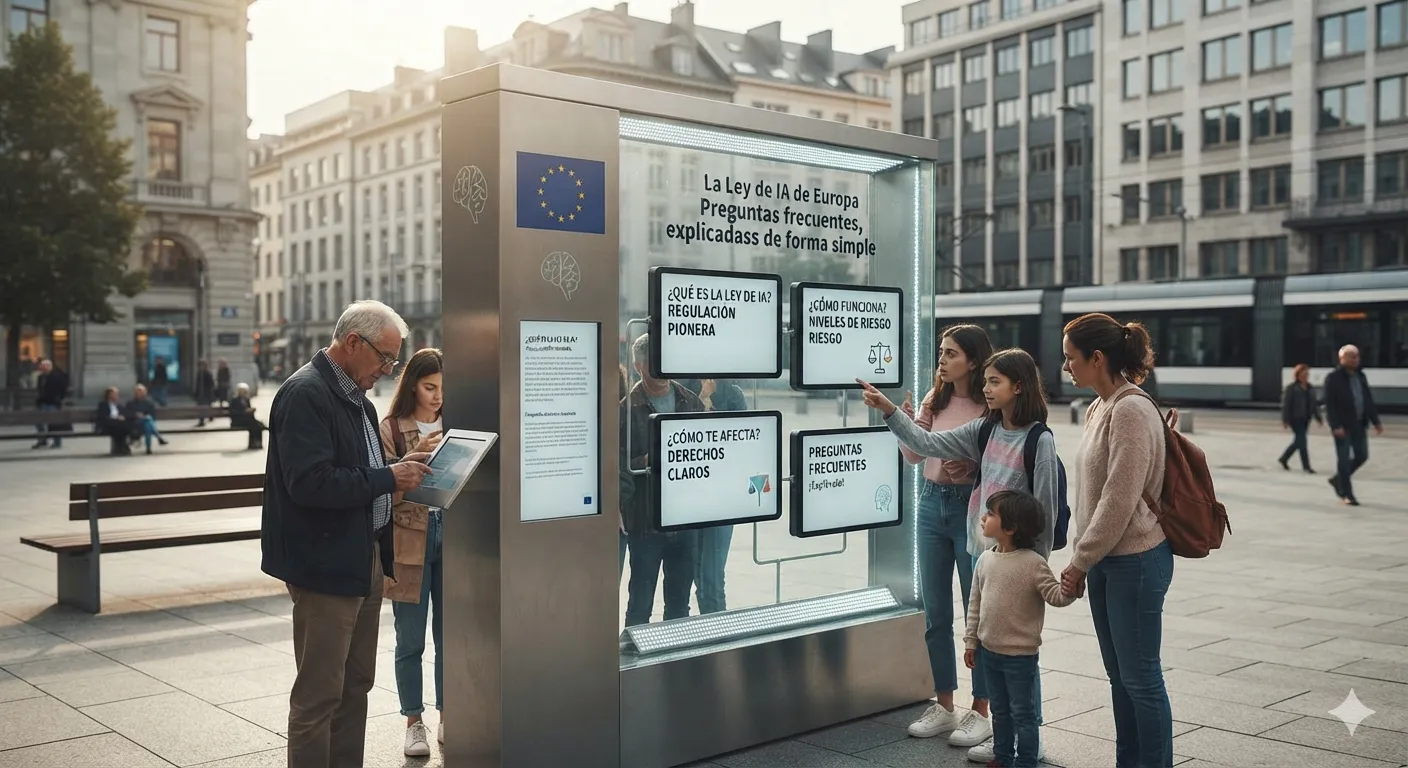
Europe’s AI Law: What Everyone Should Know
Frequently asked questions, explained simply
Introduction
The European Union created the world’s first comprehensive law to regulate artificial intelligence: the AI Act. It entered into force on August 1, 2024, and will apply in full starting August 2026, although — as we’ll see — several of its parts are already in effect earlier than that. Its goal, as the European Commission explains, is to make sure people can trust what AI has to offer, addressing risks without holding back innovation.
This law doesn’t only matter to Europe. It also affects companies in Latin America and anywhere else in the world that sell products or services in the European market, or that use AI systems reaching European users.
To make it easy to understand, this post gathers the most frequently asked questions about Europe’s AI Law, with short, simple answers based on official information from the European Commission.
1. What exactly is Europe’s AI Law?
It’s a law that sets clear rules for how artificial intelligence can be used in the European Union. It aims to make AI safe, trustworthy, and respectful of people’s rights, while still driving innovation and growth for the companies building it.
2. Why was a law like this needed?
Because many AI systems make decisions that affect people’s lives — for example, whether they get a job, a loan, or access to a public service — and often it’s not possible to know why the system decided what it decided. That makes it hard to tell if someone was treated unfairly. Existing laws didn’t cover these specific risks, so Europe decided to create a new one.
3. How does the law classify different types of AI?
The law organizes AI systems into four risk levels, like a pyramid:
- 🔴 Unacceptable risk: systems that are banned entirely.
- 🟠 High risk: systems that are allowed, but under very strict rules.
- 🟡 Limited risk: systems that must meet transparency rules (for example, telling you that you’re talking to a chatbot).
- 🟢 Minimal or no risk: the vast majority of the AI we use every day, like video games or spam filters, with no special obligations.
4. Which uses of AI are completely banned?
The law bans eight practices considered a clear threat to people’s safety and rights, including:
- manipulating or deceiving people through AI in harmful ways,
- exploiting someone’s vulnerabilities (due to age, disability, or social or economic situation),
- giving people a “social score” based on their behavior,
- predicting whether a person will commit a crime based solely on a profile,
- building facial-recognition databases by scraping photos from the internet or cameras without consent,
- recognizing emotions in the workplace or in educational institutions,
- classifying people by protected traits (like ethnicity or religion) using biometric data,
- using real-time facial recognition in public spaces for law enforcement purposes (with very limited exceptions).
These bans have been in effect since February 2025.
5. What counts as a “high-risk” system?
These are AI systems that can seriously affect people’s health, safety, or rights. Some official examples:
- AI used in critical infrastructure (for example, transportation),
- systems that grade exams or decide access to education,
- AI in medical devices, such as robot-assisted surgery,
- programs that screen resumes or manage workers,
- systems that decide whether someone gets a loan or an essential service,
- AI used in migration, asylum, or border-control processes,
- AI tools used in justice or democratic processes.
These systems must meet demanding requirements: assess and reduce risks, use high-quality data to avoid discrimination, keep activity records, thoroughly document how they work, clearly inform whoever uses them, guarantee human oversight, and be robust against failures or attacks.
6. What about generative AI, like chatbots or image generators?
Here, the so-called transparency rules apply. The idea is simple: people have the right to know when they’re interacting with a machine or when content was generated by AI. That means:
- if you use a chatbot, the company must let you know you’re not talking to a human,
- AI-generated content (images, audio, video, text) must be identifiable,
- deepfakes and AI-generated content on matters of public interest must be clearly and visibly labeled.
These rules start applying in August 2026, although systems already on the market before that date get a bit more time (until December 2026) to adjust.
7. What rules exist for large AI models, like the ones behind ChatGPT, Gemini, or Claude?
These are called “general-purpose” models (GPAI) because they can perform many different tasks and serve as the foundation for other AI systems. Since August 2025, their creators must comply with transparency rules and respect for copyright. If a model is powerful or widely used enough — and therefore may carry “systemic risks” — it must also assess and mitigate those risks more rigorously.
8. I heard Europe “delayed” the law. Is that true?
Yes, but only partly, and it’s important not to misread it. On May 7, 2026, the European Parliament and the Council reached a political agreement to simplify some rules (known as the “AI Omnibus”). That agreement moved the deadlines for the toughest obligations for high-risk systems:
- For systems used in biometrics, critical infrastructure, education, employment, migration, asylum, and border control: the rules will apply starting December 2, 2027.
- For systems embedded in regulated products (like elevators or toys): the rules will apply starting August 2, 2028.
But that’s all that changed. The rest of the law is moving forward as planned.
9. So which parts of the law are still in force and didn’t change?
Several, and they’re already active today:
- The bans on unacceptable uses (since February 2025).
- The requirement for AI literacy: organizations must train their staff to use these systems responsibly (since February 2025).
- The governance and transparency rules for large AI models (since August 2025).
- The transparency rules for AI-generated content (since August 2026, with a small extra window for systems already in use).
10. Did the reform only add more time, or did it also add something new?
It also added new things. The reform now bans, with the highest level of penalties, apps that generate non-consensual sexual or intimate content (so-called nudifiers) and systems that produce child sexual abuse material. It also:
- strengthens the powers of the European AI Office to better oversee systems built on large AI models,
- extends certain facilities for small and medium-sized businesses to “small mid-cap” companies as well, simplifying their technical documentation,
- gives more innovators access to regulatory sandboxes, including one at the EU-wide level,
- clarifies how the AI Act relates to other European product-safety rules, such as the Machinery Regulation.
11. What happens if a company doesn’t comply with the law?
It can face very high fines. Depending on how the infringement categories are defined, penalties can reach up to €35 million or 7% of global annual turnover (whichever is higher) for the most serious violations, with lower amounts for other breaches. Authorities can also inspect systems, request documentation, and order corrective measures.
12. Who does this law apply to? Only European companies?
No. The law applies to any AI provider or user whose system is used in the European Union, regardless of where the company is based. This includes companies from outside the EU — such as those in Mexico, Brazil, Colombia, Chile, Argentina, or Peru — if they:
- sell their products or services in the European market,
- develop AI solutions for European clients,
- or use AI systems that reach users in Europe.
The only major exceptions are military use, personal and household use, and pure research that hasn’t yet been placed on the market.
13. Why should this matter to a company in Latin America?
For two main reasons:
- If your business depends on European clients — very common in the tech services export sector — you’ll have to comply with these rules just like any company inside the EU.
- It’s happened before that European rules become the model other countries copy (the so-called “Brussels effect”), as happened with data protection. Several Latin American countries, including Brazil, Chile, and Peru, are already discussing their own AI laws inspired by Europe’s tiered risk approach.
14. Where can I find official, up-to-date information?
The European Commission maintains a Single Information Platform on the AI Act, where it answers questions and publishes guidelines, codes of practice, and updates to the implementation timeline. The full text of the law can also be found on the EUR-Lex portal, available in all official EU languages.
In summary
Europe’s AI Law didn’t stop moving forward: it only adjusted the timeline for its toughest rules on high-risk systems. Everything else — bans, AI literacy, rules for large models, and transparency for AI-generated content — is still moving forward as planned. And since this law can reach companies outside Europe, including those in Latin America, it’s worth understanding it now.
Source: European Commission, “AI Act” — Shaping Europe’s Digital Future (digital-strategy.ec.europa.eu), last updated May 11, 2026.