By Andrés Izquierdo | Managing Partner, IZQUIERDO PLLC
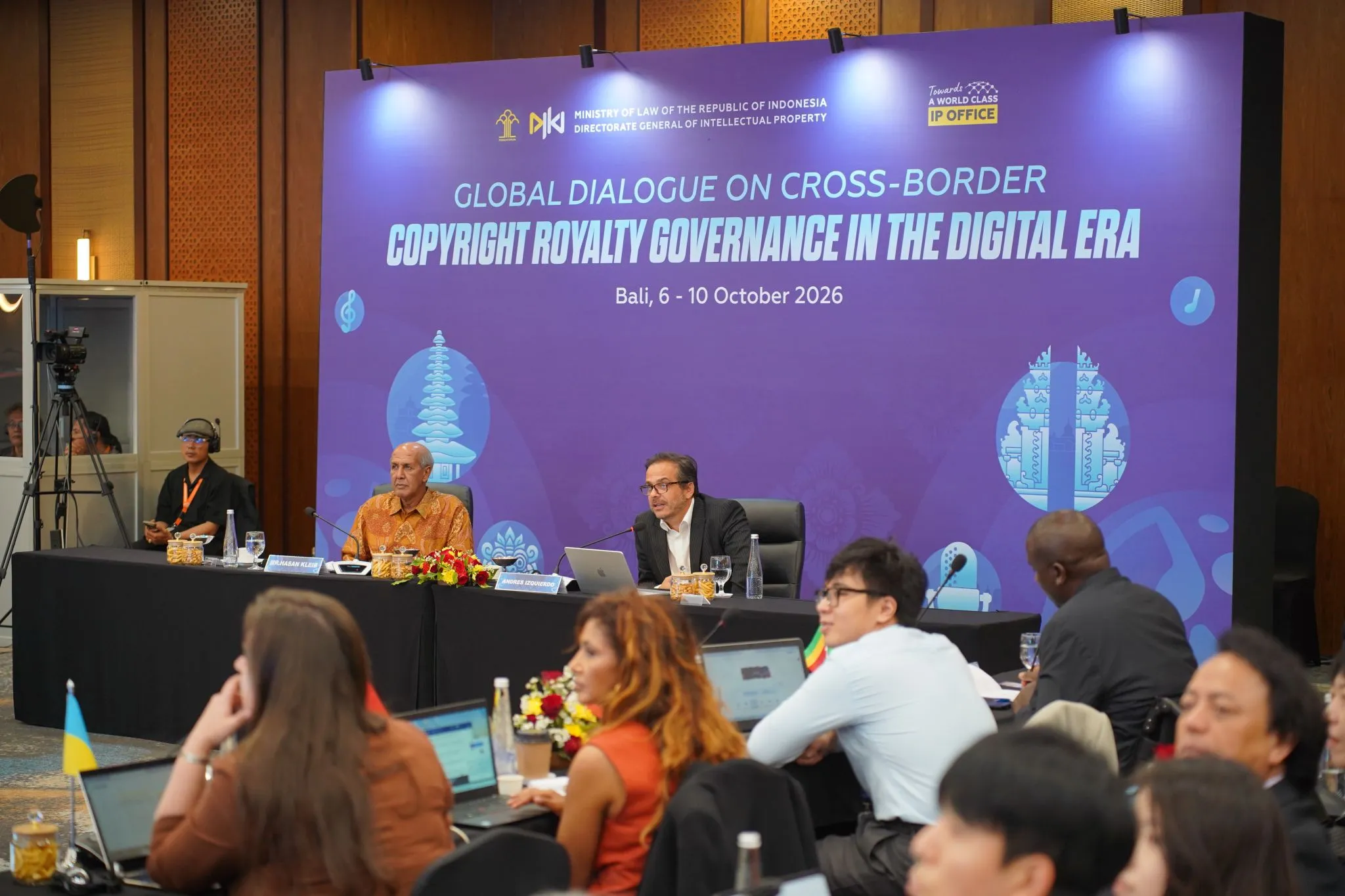
At the Global Dialogue on Cross-Border Copyright Royalty Governance in the Digital Era, held in Bali, Indonesia, on October 7–9, 2026, I participated in a panel on accountability chaired by Ambassador Hasan Kleib. Organized by Indonesia’s Directorate General of Intellectual Property, the meeting brought together governments, international organizations, and copyright stakeholders to examine the challenges of royalty governance in an increasingly interconnected digital economy.
My presentation focused on a fundamental question: What happens when music generates revenue, but the creator cannot determine where the money goes?
The answer reveals a deeper problem in international copyright governance. While legal rights are increasingly recognized across jurisdictions, the technological and institutional infrastructure necessary to administer those rights has not always kept pace with the digital economy.
The Music Was Not Lost. The Connections Were.
Consider the case of a recording artist whose career began in the 1980s. Over several decades, he developed a catalog of approximately 200 songs, received major international recognition, and accumulated more than three billion YouTube views.
Yet his monthly royalties from record companies, publishers, and collective management organizations amounted to approximately $100 USD.
This disparity does not automatically establish unpaid royalties. Digital views alone cannot determine remuneration, which depends on contracts, ownership, licensing, monetization, and other factors. Nevertheless, it raises legitimate questions about how revenue is identified, allocated, and distributed.
Our investigation revealed inconsistencies in recording identifiers, royalty accounts, and ownership information. Certain recordings were not properly connected to the artist’s royalty records. Correcting some of these errors resulted in the recovery of more than $20,000 in royalties from previous years, while further reconciliation remained ongoing.
Similar problems emerged on the publishing side, involving inconsistent musical work identifiers, attribution errors, and international administration arrangements.
The underlying problem was not the absence of copyright protection. It was the failure to connect existing rights with the data and systems responsible for their administration.
A musical work can involve two separate rights chains: the sound recording, generally identified through an ISRC, and the underlying composition, potentially identified through an ISWC. Each may involve different rightsholders, contracts, intermediaries, and payment systems.
When information becomes fragmented across these systems, identifying the appropriate recipient of remuneration becomes increasingly difficult.
The music exists. The rights exist. The revenue may exist. But the connections between them can fail.
Transparency Is Not Accountability
The distinction between transparency and accountability was central to my intervention in Bali.
Transparency allows creators to access information about the exploitation of their works and the royalties distributed.
Accountability goes further. It requires mechanisms through which creators can understand, verify, challenge, and obtain correction of decisions affecting their remuneration.
A royalty statement may indicate how much a creator received. But can the creator determine why that amount was calculated? Can errors in ownership information be challenged? Who is responsible for correcting inaccurate identifiers? And what happens to royalties from previous reporting periods when those errors are finally resolved?
These questions become particularly complex when information moves between publishers, record labels, collective management organizations, and digital platforms operating in different jurisdictions.
Importantly, accountability should not be understood as an argument against intermediaries. More reliable information and correction mechanisms can benefit the entire copyright ecosystem by improving matching, reducing conflicting claims, and facilitating more accurate distributions.
Can Artificial Intelligence Help?
During the presentation, I demonstrated IRIS, an AI-assisted copyright intelligence tool being developed at IZQUIERDO PLLC to help identify potential uses of copyrighted works, analyze available rights information, and support legal investigations.
Using the Indonesian song To the Bone by Pamungkas, the demonstration illustrated how technology could identify possible uses on YouTube, examine their digital reach, and generate preliminary estimates of associated economic activity.
Such estimates are not evidence of actual royalty payments or infringement. Ownership, authorization, licensing, and contractual entitlements must still be verified.
Nevertheless, these technologies could significantly improve the ability of creators and legal professionals to investigate discrepancies across fragmented copyright systems.
The challenge is ensuring that AI does not simply introduce another layer of automated, unexplained decision-making.
Technology can improve transparency. But accountability still requires explainability, verification, and effective correction mechanisms.
Beyond Legal Reform: Connecting the Copyright Ecosystem
International copyright modernization is often approached primarily as a legislative challenge. However, legislation alone cannot repair inaccurate metadata, reconcile incompatible databases, or determine responsibility when automated royalty allocations fail.
A functioning digital copyright ecosystem requires the integration of four elements: technology, governance, economics, and law.
Existing infrastructure, including international identifiers, technical standards, collective management systems, and initiatives such as WIPO Connect, already provides important foundations.
The challenge is not necessarily to replace these systems with a single global database. Rather, it is to ensure that they can exchange reliable information and operate within clear accountability frameworks.
This requires interoperability, but also institutional cooperation and meaningful participation by developing countries in designing the systems that will govern their creative economies.
Ultimately, rights must connect to data, data to technology, technology to governance, and governance to the economic value generated by creative works.
From Legal Rights to Digital Reality
Indonesia’s initiative to advance international discussions on copyright royalty governance provides an important opportunity to reconsider how copyright systems function across borders.
The discussions in Bali demonstrated that the international copyright community is not starting from zero. Legal rights, identifiers, databases, collective management organizations, technical standards, and increasingly sophisticated technologies already exist.
What remains fragmented are the connections between them.
Modernization therefore requires more than additional legislation or technological innovation. It requires governance structures capable of ensuring that information moves reliably across institutions, that decisions affecting remuneration can be explained, and that errors can be effectively corrected.
At IZQUIERDO PLLC, our work increasingly focuses on this intersection of international copyright governance, AI-assisted rights intelligence, and cross-border royalty accountability.
The future of copyright protection will depend not only on recognizing rights but also on ensuring that those rights function effectively in the digital economy.
Follow the music. Follow the data. Follow the money.
Because accountability ultimately means that creators should be able to understand what happened to their works, what happened to their royalties, and what they can do when the two no longer connect.
Andrés Izquierdo is Managing Partner of IZQUIERDO PLLC, a Washington, D.C.–based international law firm, and Senior Researcher at American University Washington College of Law. He previously served as Legal Director for Sony Music in the Andean Region. His work focuses on international intellectual property, artificial intelligence, and cross-border transactions.